
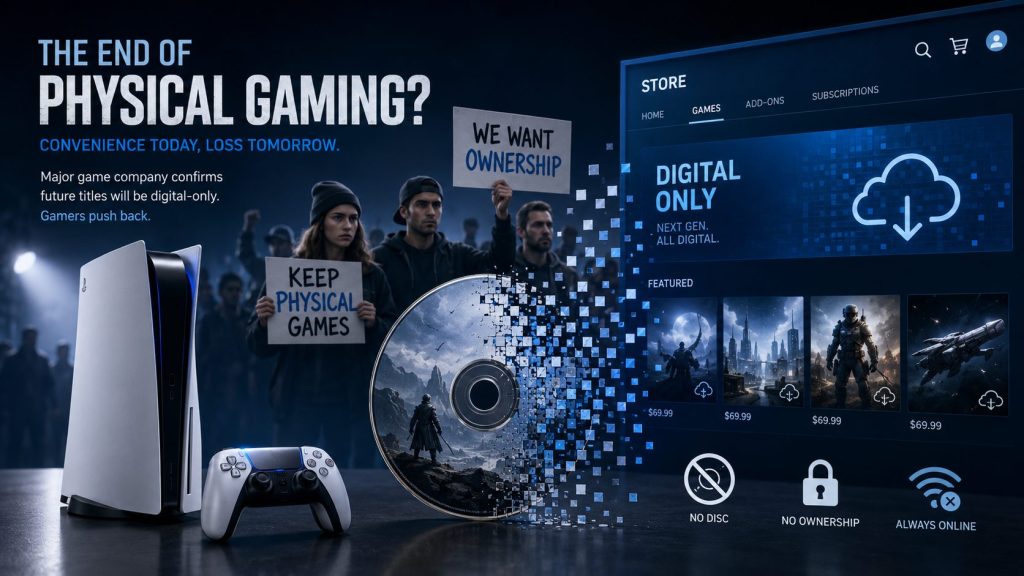
Sony’s decision to end production of physical PlayStation game discs for new releases starting in January 2028 has sparked a major backlash among gamers, collectors, retailers, and consumer-rights advocates.
While Sony points to changing buying habits and the growing popularity of digital downloads, many PlayStation owners see the decision as something much bigger than a format change.
For these players, the debate is about ownership, consumer choice, resale rights, game preservation, and whether purchasing a digital game truly means owning it.
On July 1, 2026, Sony Interactive Entertainment officially announced that new PlayStation games released beginning in January 2028 would be available only in digital formats, including through the PlayStation Store and retailers.
Importantly, Sony stated that the change would not affect games already released on disc or those scheduled for disc release before January 2028.
But that distinction has done little to quiet the controversy. Many players believe digital convenience should remain an option rather than become their only choice.
Is Sony Really Ending Physical PlayStation Games in 2028?
Yes. Sony has confirmed that physical disc production for new PlayStation games will end starting in January 2028.
According to Sony’s official PlayStation announcement, the transition will apply to new games released after the cutoff.
Here is what the announcement means for players:
- New PlayStation games: New releases beginning in January 2028 will be distributed digitally rather than on playable game discs.
- Existing physical games: Games released on disc before the cutoff are not affected by the announced production change.
- Retail purchases: Retailers may continue selling new games in digital formats, but a physical box containing a download code is not the same as a playable disc.
- Used games and collecting: The transition will eventually reduce the availability of new physical releases for trading, lending, and resale.
Sony acknowledged strong reactions to the announcement during its July 31, 2026 earnings discussion. However, company leadership indicated that the transition would move forward cautiously.
Digital Game Sales Are Growing, but Physical Games Still Matter
Sony has a legitimate business argument for moving toward digital distribution: most PlayStation games are already purchased digitally.
According to Sony’s financial reporting, digital downloads accounted for 78% of PlayStation 4 and PlayStation 5 full-game software unit sales during fiscal year 2025.
That is a significant majority, but it also means approximately 22% of full-game units were not digital downloads.
Across hundreds of millions of annual game sales, that represents a substantial physical market.
These figures also need to be interpreted carefully. Sony’s full-game download ratio measures units sold digitally compared with total full-game units. It is not a measure of the percentage of gamers who prefer digital purchases, nor does it account for every type of gaming transaction.
Sony’s published PlayStation sales data demonstrates the enormous scale of the gaming market.
Digital sales may show where the market is heading, but they do not prove that physical media has lost its value or that players want physical games eliminated.
Physical Games vs. Digital Games: What Do You Actually Own?
One of the biggest concerns surrounding Sony’s decision is the difference between owning a physical game and purchasing digital access.
When someone buys a physical game disc, they generally possess a copy they can keep, lend, trade, resell, or collect. Physical ownership does not eliminate copyright restrictions, and some modern games still depend on downloads, online authentication, or servers.
Nevertheless, a playable physical copy can provide more independence from a digital storefront.
Digital purchases operate differently. Players generally receive a license to access software under the platform’s terms and applicable laws. That access can depend on account status, licensing arrangements, platform support, and other restrictions.
For consumers, the distinction raises an important question:
If you pay full price for a digital game, should the company selling it be able to limit or remove your access later?
That concern is not unique to PlayStation, but Sony’s recent history with purchased digital video content has brought it into sharper focus.
Sony’s Digital Content Controversies Raise Ownership Questions
In December 2023, PlayStation notified customers that previously purchased Discovery television content would be removed from their video libraries because of licensing arrangements.
Sony subsequently reversed that planned removal after reaching updated licensing arrangements. The content remained available, but the original warning demonstrated how digital purchases can depend on agreements beyond the customer’s control.
Then, in June 2026, Sony notified PlayStation customers in the United Kingdom that access to 551 previously purchased StudioCanal movies and television titles would end on September 1, 2026.
Reports identified affected films including Terminator 2: Judgment Day and Apocalypse Now. The announcement cited licensing agreements, and reports indicated that Sony did not offer affected customers refunds.
These examples concern digital video purchases rather than PlayStation games, so they should not be interpreted as proof that Sony plans to remove purchased games.
However, they illustrate why consumers are concerned about relying entirely on digital libraries.
For players considering an all-digital PlayStation future, the central concern is straightforward: what happens to purchased content when licensing agreements, platform policies, or online services change?
Why Gamers Are Fighting Sony’s Decision
The backlash against Sony’s announcement has extended beyond social media complaints.
Canadian game retailer PNP Games launched the Don’t Kill the Disc petition on July 1, 2026, urging Sony to preserve physical PlayStation releases.
The petition has attracted hundreds of thousands of verified signatures, reflecting significant opposition to the transition.
Its central argument is not that digital games should disappear. Rather, supporters want physical and digital formats to coexist.
That distinction matters.
Digital games offer meaningful advantages. Players can download titles without visiting a store, switch games without changing discs, and maintain large libraries through a single account.
However, physical games provide benefits that digital storefronts cannot fully replicate:
- Trading or reselling games after finishing them.
- Lending games to friends and family.
- Buying discounted used copies from independent retailers.
- Collecting physical editions and preserving gaming history.
- Playing compatible offline games without depending entirely on future downloads.
Some frustrated players have adopted a “no disc, no buy” position, threatening to stop purchasing future PlayStation products if physical releases disappear.
Whether that reaction ultimately changes Sony’s plans remains uncertain.
Will Digital-Only PlayStation Games Cost More?
Another major concern involves pricing and competition.
Physical games create a marketplace where multiple retailers can compete on price. Stores can discount inventory, offer trade-in incentives, and resell previously owned copies.
Players can also sell games they no longer want and use that money toward their next purchase.
Digital-only distribution changes those dynamics.
Although Sony says retailers will continue offering games in digital formats, consumers would lose the traditional used-disc marketplace for newly released PlayStation titles.
Publishers and approved digital storefronts would consequently have greater influence over how games are priced and distributed.
That does not necessarily mean digital games will always cost more. Digital storefronts frequently offer discounts, seasonal promotions, and subscription-based access.
But those promotions are not equivalent to an independent resale market where consumers can determine the value of used copies.
The issue is not simply whether digital games can be inexpensive. It is whether eliminating physical games reduces the number of ways consumers can find a better deal.
What Happens to Game Preservation Without Physical Discs?
Game preservation is another important part of the debate.
Video games represent decades of creative work, cultural history, technical innovation, and entertainment. Preserving access to older games matters to players, collectors, researchers, and historians.
Digital distribution can make games widely accessible while storefronts and supporting services remain available. However, those same games can become difficult to obtain when they are delisted or when services close.
Physical discs are not a perfect preservation solution. Some modern releases require large downloads, patches, online verification, or persistent server connections.
Still, a complete playable disc may remain usable long after a digital storefront stops selling the game.
Collectors also value physical editions for their artwork, packaging, manuals, and historical significance.
Moving entirely away from physical games removes one more method of preserving gaming history independently of online distribution platforms.
Why PlayStation’s Digital Future Is Also a Question of Trust
Sony’s greatest challenge may not be convincing players that digital gaming is convenient. Millions of consumers already understand its benefits.
The bigger challenge is convincing players that their purchases will remain accessible and that they will retain meaningful control over what they buy.
Consumers are accustomed to purchasing games, movies, books, and music with the expectation that those products will remain available to them.
Digital licensing arrangements can complicate that expectation.
For PlayStation customers who have spent years building game libraries, the end of physical discs raises questions about what those collections will mean decades from now.
Will purchased games remain downloadable? What happens if a storefront closes? Will players still be able to access games that require online services?
These questions do not have one universal answer because access depends on the game, license, hardware, and services involved.
But they deserve attention before physical alternatives disappear.
Can Sony Reverse Its Decision to End PlayStation Discs?
Sony has announced its plans for January 2028 and reaffirmed that direction despite public criticism.
That does not make a change impossible. Companies can reconsider product and distribution strategies when consumer demand, competitive pressure, or market conditions warrant it.
However, there is currently no confirmed reversal of Sony’s announced disc-production cutoff.
For players who want physical games to remain available, petitions, purchasing decisions, and direct feedback are ways to communicate that preference.
The long-term outcome will depend on whether Sony believes maintaining physical distribution provides enough value to justify the associated costs.
Final Thoughts: Digital Convenience Should Not Eliminate Consumer Choice
Sony’s plan to discontinue physical PlayStation game discs for new releases may make sense from a business perspective.
Digital distribution can reduce manufacturing and distribution costs, simplify logistics, and provide companies with greater control over their marketplaces.
But what benefits a platform financially does not always provide the greatest benefit to consumers.
For many gamers, physical media represents something that digital storefronts cannot fully replace: control over a purchased copy.
A disc can be collected, resold, borrowed, or passed down. A physical game can also represent a personal memory, a collector’s item, or a piece of gaming history.
The backlash against Sony is not simply nostalgia or resistance to technological change. It reflects concerns about ownership, affordability, preservation, and the future of consumer choice.
Digital gaming is clearly here to stay. The question is whether that future really requires physical games to disappear.
For hundreds of thousands of players supporting the campaign to preserve PlayStation discs, the answer is no.
What do you think? Would you continue buying PlayStation games if digital downloads became your only option, or is physical ownership important enough to influence your next console purchase? Share your thoughts in the comments.